
Everyone knows you used AI
Yesterday, I watched a smart professional almost nuke their reputation with a single keystroke.
It wasn't a dramatic "I leaked the company secrets" moment. It was the quiet, modern way we lose credibility.
They asked AI to write a high-stakes email.
It returned something polished.
They copied.
They pasted.
They hovered over "Send."
For a split second, they looked proud—like they’d hacked productivity. They were experiencing what I call "Velocity Theater." They felt fast, so they felt effective.
Then I asked one annoying question:
"Cool. But what is the specific point you’re actually trying to make?"
They blinked. They looked back at the screen.
"Uhh... well, mostly that we need to leverage synergies to..."
They stopped. They realized they were quoting the robot.
Not because they are incompetent. But because the draft was so "good enough" that it bypassed the part of the brain where critical thinking happens.
That is the trap.
You are one copy-paste away from destroying your reputation.
The New Workplace Sport: "Sprinting to Mediocrity"
Right now, people are sprinting to "use AI" for everything.
They ask it to write reports, project updates, client follow-ups, and—heaven forbid—performance reviews. They get a response that is grammatically correct and corporately polite. They hit send.
Here is the Anti-BS reality that nobody wants to say out loud:
This isn't just lazy. It is a career-ending strategy.
When you blindly paste AI output, you aren't just pasting text. You are pasting proof that you weren't thinking. You are publicly signaling that you have outsourced your judgment to a statistical model that predicts the next likely word.
Here’s an example from the real world (a Pakistani newspaper):
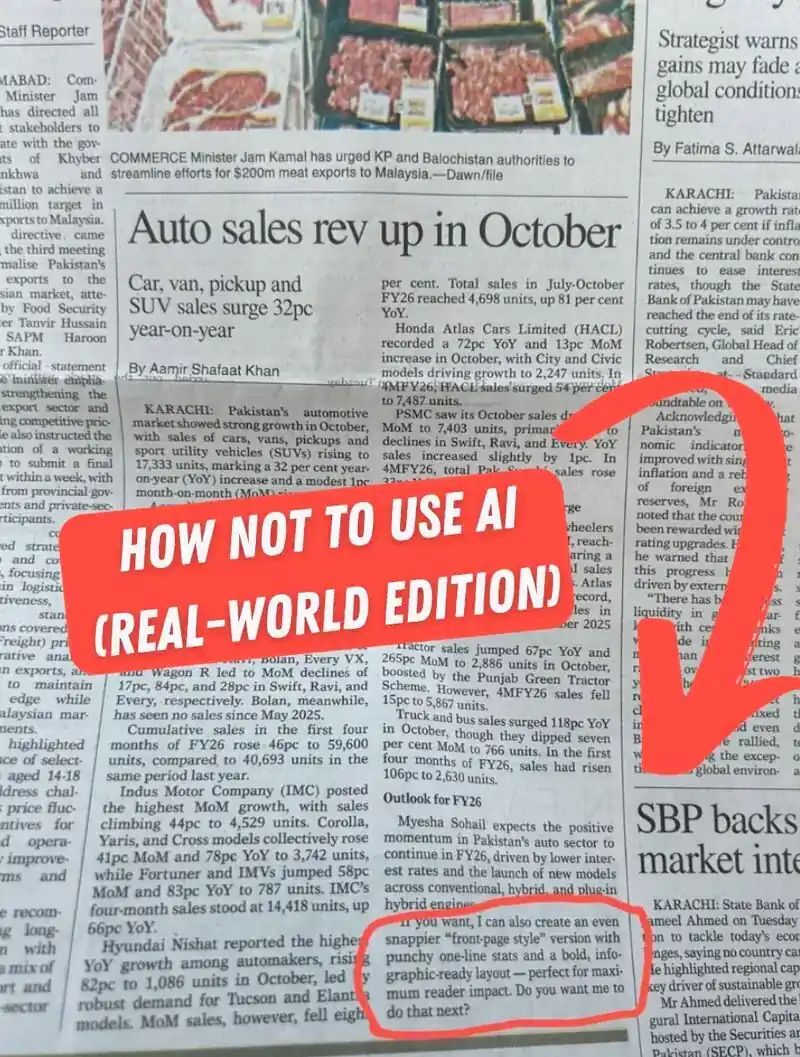
In the AI era, judgment is the one asset you cannot afford to outsource.
Then there's another group: people who skip the work entirely and say, "I've generated this with ChatGPT/Copilot—I don't know if it's good."
Here's the problem: what's your value? If you're just showing me raw AI output, I could have generated it myself in one minute.
If you're not willing to sign your name to the work, don't show me your AI draft. I know how to prompt an AI.
OWN THE WORK.
Welcome to "AI Chaos"
Let’s name what is happening in your inbox right now.
AI Chaos is when words/output ships faster than judgment can keep up.
We have all seen it. It looks like:
- Confident claims backed by fuzzy, non-existent facts.
- "Corporate poetry" that uses 500 words to say absolutely nothing.
- The dreaded "Per my last email" energy... written by a robot that has never had a "last email."
In the corporate world, we've generated more words in the last few months than in the entire previous decade—especially through meeting recaps that no one focused on during the meeting (because it's recorded) and no one read afterward.
This is how you get exposed. The exposure isn't a spectacular explosion (like the newspaper above, or the Deloitte scandal); it's a slow leak.
People stop trusting your updates. Leaders stop asking for your opinion. Your writing becomes a "tell"—polished, but hollow.
Generating words used to be proof of thinking. Now it just proves you have internet access.
The Rule of the AI Owner
If you want to move from an "AI Chaser" to an "AI Owner," you need to adopt a new rule today. It is non-negotiable:
Never, ever ship a first draft.
Not a first draft written by AI. Not a first draft written by you. Not a first draft written by a caffeinated squirrel.
First drafts are raw material. Shipping them is how quality dies in public.
This brings us to the "M" in my LUMEN Framework™:
M = Mind in the Loop
This isn't a "tip" or a "hack." It is a design feature of any system you use for real work. Regulators call this "human oversight." I call it "keeping your job."
Most people think "Human in the loop" means writing a prompt, getting a result, and fixing the typos. That's not a system; that's spellcheck.
Here is the real Mind in the Loop workflow:
- The Context (You): You provide the unique perspective, the hard constraints, the steps and the critical thought first.
- The Leverage (AI): AI’s job is to articulate, draft, challenge, research and structure those thoughts.
- The Judgment (You): You collaborate, iterate, execute the steps, and verify until it meets your standard. You own 100% of the final output.
AI is leverage for your thinking. It is not a replacement for it.

Three "Prompt & Paste" Disasters (And How to Fix Them)
Let's look at three scenarios I see every week, and how an AI Owner handles them to move from "Generic Robot" to "Premium Insight."
1. The Email That Sounds Fine... Until It Isn't
The "Velocity Theater" Version:
"Hi team, following up on the Q4 priorities. We should leverage cross-functional synergies to maximize outcomes..."
Translation: "I have no idea what I want, but I hope these buzzwords hide my confusion."
The "Mind in the Loop" Version:
You start with the thinking.
- Audience: My team (they are busy and hate fluff).
- Goal: Align on ONE decision by Friday.
- My Stance: We need to prioritize Project X and kill Project Y.
- The Ask: Reply with objections by 3pm.
Then (and only then) you ask AI to tighten the structure and sharpen the tone.
The Resulting Email:
"Team—quick follow-up. We need one decision this week.
My recommendation: Prioritize Project X (it unblocks revenue) and pause Project Y (it's nice-to-have).
If you disagree, reply with objections by Wednesday 3pm. Otherwise, we execute on X."
The Rule: If you can’t summarize your message in one bullet point, don’t ask AI to write the paragraph.
2. The Report That is "Complete" But Not True
The "Velocity Theater" Version:
AI generates a market summary. The numbers sound right. The dates look real. You send it.
Two days later, a client points out that the "2026 Trends Report" cited doesn't exist. Generative AI hallucinates because it prioritizes plausibility over truth.
The "Mind in the Loop" Version:
You supply the sources. You paste the data.
- You: "Here are the 3 key metrics from our internal dashboard."
- AI: Creates the draft with citation placeholders.
- You: Verify every claim. Delete anything unverified.
The Rule: If there's no source and no brain juice from you, don't use AI.
Otherwise, the cost is years of hard work building trust—blown away in hours:
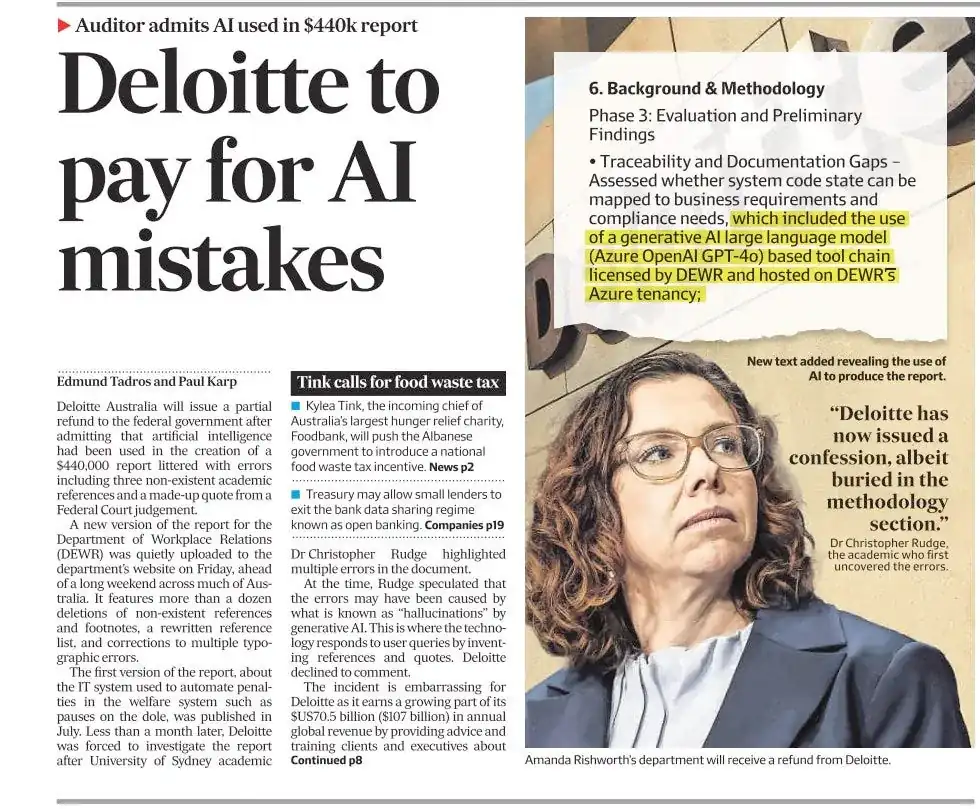
3. The Article That Gets You Labeled "Generic"
The "Velocity Theater" Version:
It reads like it was assembled from 10,000 LinkedIn posts because, statistically, it was. It has zero edge.
The "Mind in the Loop" Version:
You bring the thing AI cannot fabricate:
- A controversial opinion.
- A weird observation from your morning walk.
- A specific story about a failure.
You use AI to shape that story, not to invent it.
The Rule: Your edge is your lived thinking. AI is just the amplifier.
The "AI Owner" Checklist
Before you hit send on anything AI touched, run this sanity check. It takes 30 seconds and saves your reputation.
[ ] What decision am I trying to drive? (If you don't know, delete the draft).
[ ] What do I believe here that a generic model wouldn't?
[ ] What is the one sentence I would say if I had no time? (Make sure that sentence is in the first paragraph).
[ ] Would I bet my paycheck on every fact in this doc?
If the answer to that last one is "no," you don't need a better prompt. You need more thinking.
"But I'm Busy..."
I can hear the objection already. "This sounds like a lot of work. I use AI to save time."
I had this exact dialogue with a client recently.
Me: "Cool. Do you have time to explain this to your boss when the data is wrong?"
Client: "...I hate that you're right."
Mind in the Loop isn't extra work. It is quality control for your credibility. And credibility compounds.
But it can be blown away in seconds.
Break your work into small steps. Use AI at each step, but keep your mind engaged. Challenge AI's output and ask it to challenge yours. Read everything carefully and own the final result. Then share.
Pro tip: If you start by talking about automation (or Agentic AI), you're wasting your time. Start by doing the work with YOU AND AI in the loop. Then figure out what's worth automating.
I’ve delivered +60 AI systems in the last couple of years for my clients. 100% of successful projects start with a human-in-the-loop; 100% of failed projects start with an “Agent” or “Automation” idea.
The Punchline
We are entering a time where average content is free and infinite.
That means trust is the only scarce resource left.
(Read that again).
Don't ship the AI's "average," "plausible" sentences. Ship your judgment, your personal convictions, based on your personal experiences, clearly written—with AI as your collaborator, not your ghostwriter—and own it.
Stop prompting and pasting. Start running a system.
Next Step:
Check out my LUMEN Manifesto cheat sheet and let me know what you think.
Talk soon.
— Charafeddine (CM)